|

Featured Guest
Amanda D. Lotz
Amanda D. Lotz is an American-Australian media scholar whose research has deeply influenced contemporary understandings of media industries, television history, and digital disruption. She is a Professor at Queensland University of Technology and leads the Transforming Media Industries research program at the Digital Media Research Centre. Lotz holds a B.A. in Communication from DePauw University, an M.A. in Telecommunication from Indiana University Bloomington, and a Ph.D. in Radio, Television, and Film from the University of Texas at Austin. Her scholarship, which articulates pivotal concepts such as the network era, post-network era, and multi-channel transition, has been central to the study of how television and media markets evolve amid technological change. Lotz is the author, co-author, or editor of numerous influential books – including The Television Will Be Revolutionized, We Now Disrupt This Broadcast, and Media Disrupted – and her work has been translated into multiple languages. Her contributions to the field have been recognized through several honors, including election as a Fellow of the International Communication Association, designation as a Peabody Fellow Scholar, and awards such as Coltrin Professor of the Year from the International Radio and Television Society, along with fellowships and grants from the National Association of Television Program Executives and the Academy of Television Arts & Sciences Foundation.
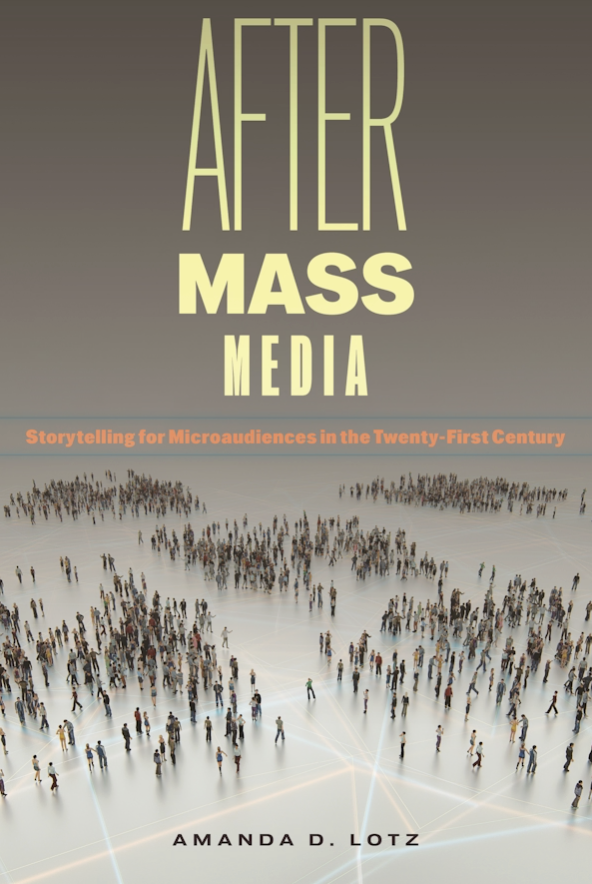
This year, we discussed her most recent book After Mass Media: Storytelling for Microaudiences in the Twenty-First Century (New York University Press, 2025).
What motivated you to write After Mass Media, and how does it build upon or diverge from your earlier work on television and digital media?
After Mass Media has been percolating in my head for about twenty years. When I wrote The Television Will Be Revolutionized (2007), it became clear that the normality of "mass media" had begun to erode and that the emerging digital technologies would further change the shared societal experience of shared media consumption. Until recently, it has been difficult to identify the scale of the fragmentation or its consequences.
I also felt I needed to understand the new industrial conditions – the world of on-demand access and no, or less, reliance on advertising. That took longer than I expected. I always hoped to arrive at a project that would connect the industrial changes of digitization that I've written about for the last decade with investigation into the textual and cultural implications of those changes. That was my aim with After Mass Media.
You argue that the concept of "mass media" is no longer adequate for understanding our current media environment. What do you see as the most misunderstood legacy of the mass media era?
I think we've forgotten how widely shared media culture used to be and that we commonly think today's "hits" are similar to that norm. We hear things like "five million followers," but that is a metric that has no antecedent. Even something with five million views is difficult to conceptualize. First, those are worldwide totals, which isn't how most media were ever accounted. Secondly, they accrue over time. To put five million views in context, we need to data points like how many times anyone in the world has watched a typical Friends episode.
Tell us about "choice" in the context of your research.
Choice for me is foremost numerical. The 1980s cable system I grew up with had nineteen channels. There were nineteen things I could watch at any time. There are five thousand titles in most Netflix libraries. YouTube's catalog was estimated at ten billion videos at the end of 2022. That's what I mean by choice.
Also, the discussion of the emergence of multiple modes of industrial practice makes an argument for a meaningful diversity of types of professional (licensed) scripted drama/comedy increasing the range of series available in addition to that quantitative choice. Much of our network era choice was among three commercial broadcasters operating under the same logics and all making content trying to attract the most people. The blend of subscriber and ad funding has made different storytelling strategies possible. We have "spectacular" series like Game of Thrones and detailed, introspective "character studies" like Somebody, Somewhere.
I hear the concerns about algorithms, but it is time to do research that talks to people about how they use media and how they feel about it. Choice has always been shaped by those that manage media circulation. For decades, it was shaped by network programmers. Algorithms are far from unprecedented.
What implications does the decline of mass media have for the idea of a shared public sphere or collective cultural experience? Are we losing something vital in the fragmentation?
I guess it depends on who "we" is. I don't have a lot of patience for the nostalgia that forgets that the world on offer that "we" collectively shared was a world of straight, white, male protagonists and characters who never worried about missing a payment. So many realities were absent from that collective experience.
It is disorienting – as someone who trained in the late 1990s by reading twentieth century media theory – to realize media don't operate with the same mass reach now, but that is not the only way they have personal or societal importance. My sense is that the media content we engage with – and there is little evidence that we are engaging with less – remains profoundly meaningful and important. That is a process that desperately needs more attention and gets overlooked when we insist on only chasing after the things that still get the most attention.
If we investigate the fragmented audience, we may find media content playing really important roles, and even quite different ones than were the case of a mass media era in which a lot of people were consuming a lot of content that they didn't really love or find meaningful. I'm much more interested in understanding what role media plays now than fretting over the loss of that past world.
How will other media educators and policy regimes be impacted by this book?
This book speaks to the media scholars whose work and thinking contributes to the understanding of decisionmakers who shape the industry. We all need to be doing a lot more work to understand how media work today. We also need to do research that tests the continued relevance of the ideas built in another era as well as undertake investigations willing to forget that past and understand today on its own terms. Many policy regimes remain tied to twentieth-century norms and are no longer fit-for-purpose. We don't just need new versions of policies that made sense in an era of scarce content and mass audiences, but we need policies designed for how media work now.
If you were to extend After Mass Media five years into the future, what emerging technologies or platforms would you be paying closest attention to – and why?
After Mass Media focuses on scripted fiction – series and movies, the type of content that remains very time and labor intensive and so has not been replicated by the "hosted" media-making present on YouTube and social media. Of course, media consumer time is finite, so the growing time spent with other media has implications on the scale of the market for series and movies, but the desire to watch scripted series and movies seems to operate somewhat distinctly from other types of media consumption. That is a long way to say, we don't understand much about what is going on with social media, YouTube, and TikTok use and that is something I’d like to understand more deeply.
Leslie Kreiner Wilson, Interviewer and Editor
https://americanpopularculture.com/journal/articles/fall_2025/lotz.htm
Back to Top
Journal Home
|