
"Hardly Human":
The Woman Who Toils and
Undercover Narrative as Alternate Reality
Americana: The Journal of American Popular Culture
(1900-present), Spring 2026, Volume 25, Issue 1
americanpopularculture.com/journal/articles/spring_2026/hapke.htm
Independent Scholar
|
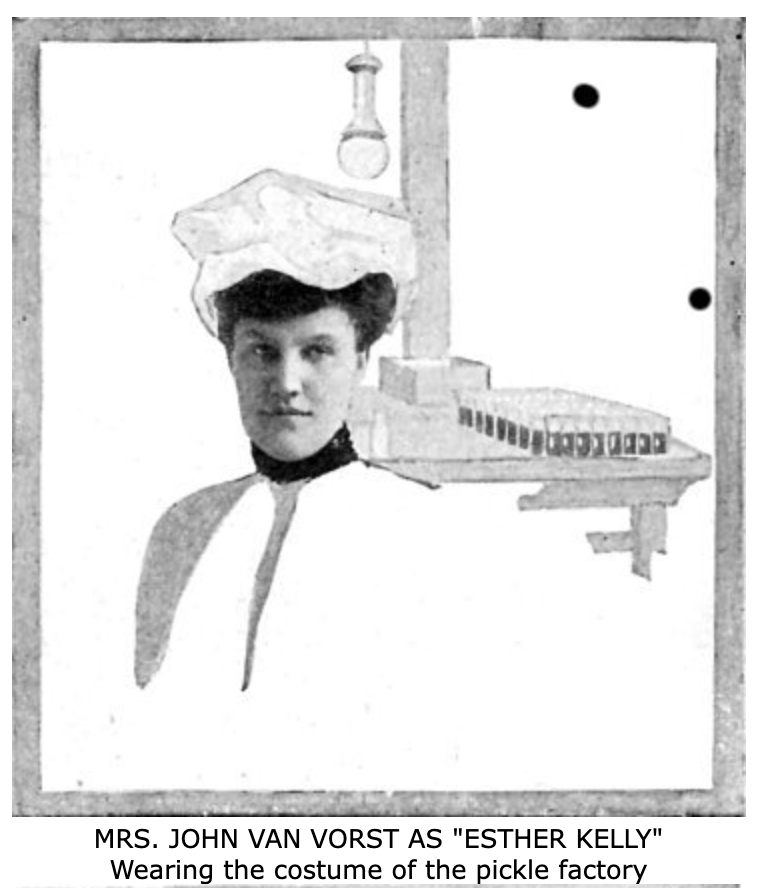
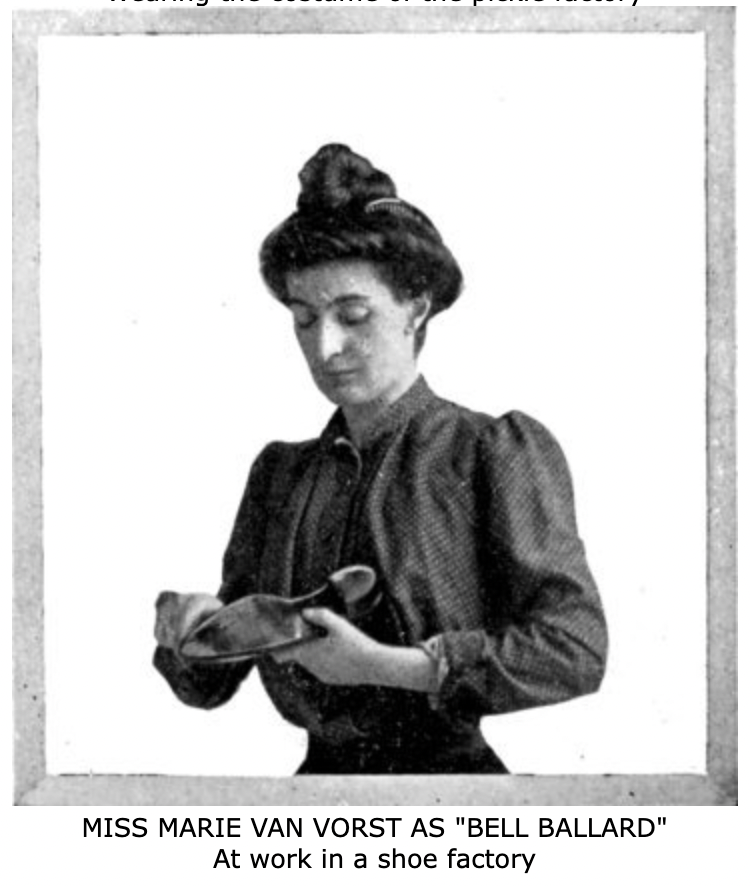
Introduction In the early twentieth century, a subgenre created by women reporters, the industrial undercover narrative, catered to a popular fascination with the feminine working class which helped fuel the nation's factories, mills, and sweatshops. Central to launching the new form was The Woman Who Toils: Being the Experiences of Two Gentlewomen as Factory Girls (WWT), published in 1903 by Bessie Van Vorst and her sister-in-law Marie.1 An expanded version of pieces in the middlebrow Everybody's Magazine, it remained on the best seller list for six months, was lauded in Great Britain, translated into French, and endorsed by President Theodore Roosevelt, who supplied a testimonial "Prefatory Letter." Given this reception, WWT was credited as a model for the "toiling ruse" subgenre of the early 1900s. A New York Times book review was similarly enthusiastic ("Two Ladies" 30). Exclaimed another fulsome reviewer as well, "these two ladies deserve great credit for their discoveries" (Colbron 47). The lady-reporters posed for weeks as workers in venues as diverse as a Pittsburgh cannery; a Lynn, Massachusetts, shoe factory; and Columbia, South Carolina, textile mills. Leavening the study were illustrations and photos of workers bent over their tasks. Validating their own expertise, the two capitalized on the respective transformations by touched-up frontispiece photos in their workaday uniforms, subtitled Bessie Van Vorst, aka "Esther Kelly" (figure 1) and Marie Van Vorst aka "Belle Ballard" (figure 2). There was little precedent for their narrative personae, framing and mapping devices, and attention to detail. Articles by early undercover sociologists Eva Gay and Annie Marion MacClean did attract notice, as did daredevil journalist Nelly Bly. But such initiatives did not address the modern factories fast becoming the norm (Todd 18-19, 333). A partial exception was Agnes Nestor's valuable account in diary form of worklife in a glove factory, but it went unpublished until an excerpt appeared in 1954. In contrast, an added innovation for the well-known Van Vorst newswomen was their status as recipients of a genteel upbringing. They could easily point to the forces preventing ladylike – or even appropriate – behavior. The period response to their Old Money background was not unmixed: otherwise positive assessments found pervasive condescension. Rediscovered in the 1970s wave of scholarly interest in women's labor history, the consensus was the elitism of these women was unremarkable for its time. Leslie Woodcock Tentler saw a valuable record of "work group solidarity" and a "rational view of [woman's] work world" (63). Industrial relations scholar Roger Keeran maintained that WWT filled an epistemological gap with its "rare glimpse into dreary factories and crowded boarding houses" (550).2 References of this sort increased with the feminist expansion of working-class studies. By the digital age, and now in the public domain, reprints proliferated, from the free Project Gutenberg site to sales on Amazon with eye-catching names like Public Domain and Forgotten Books. In these examples of internet accessibility, the volume was offered as ideal for readers curious about industrial eye witnessing of the brutal conditions and low pay for women. Offered without charge (but difficult to read), Project Gutenberg praised the book's understanding of "the struggles, hopes, and aspirations of the female labor force…It challenged the perceptions of poverty and class from the perspective of those who toil in the factories." This illuminating approach, summarized by Melinda Strong, was that these daughters of privilege cleverly "employ[ed] deception to reveal injustice." The elitism noted in earlier decades had all but disappeared. My article interrogates all of these assertions. I analyze the style and substance of what sociologist Caroline Auer terms "false representations" (170). To unpack this argument is to study how, beneath the patina of verisimilitude, diluted outrage, and questionable sympathy, WWT plays on cultural fears of and fantasies about female toilers. In service to this specious argument, whether applied to the bottle factories of the Midwest or the textile mills of the South, they devised a discourse of female labor primitivism. Neither Bessie nor Marie Van Vorst acknowledged the subjectivity of such a debasement narrative. It was not until over a century later that the first Trump administration, defending its own dismissal of unwelcome evidence, gave a name to that dubious rationale. In one of many interchanges, Kelly Anne Conway, counselor to the president, averred that the White House provided reliably "alternative facts and…information" on Meet the Press. The media pushback was understandably widespread. Reading WWT through the Trumpian dictum, I find that it too gave opinion the force of fact. But in light of the book's positive reception, the Van Vorsts' elision of the accurate and the judgmental did not stir debate. As the aristocratic sisters-in-law reflected and reshaped both the classed anxieties and the misogyny of the era, their own representations successfully constructed the uncivilized factory woman.
Figure 1
Bessie among the Creatures: Pittsburgh Bessie chose Pittsburgh for the vast numbers of girls who work in the factories of an archetypal labor city. Cannery work, probably in a Heinz factory, provided the most representative experience of the grueling processes characterizing such work. With its melodramatic flourish and lachrymose tone, words authenticate her own distinctiveness. At the same time, her use of the passive voice separates her from the mass:
Well before that, the picture prefacing such odes to harshness validates her alone: she is both lady and fraudulent worker. In the term of an historian of women's clothing, it is "display that obscures" (Hollander 72). The focus is on her alone. Hers is a visual rhetoric of the pristine. Rather than her actual appearance at the end of a day, she looks as if her real-life "tidy maid" had starched and ironed her uniform (9). Literally and figuratively superior, she is a giant compared to the factory itself, a figure of grandeur, armed with the expertise of an incognito investigator. Both mythological and human, she alone is illuminated by a single shopfloor light bulb. Although her face is pasted into a hat and uniform, the clumsy technique emphasizes her intelligent mien. This is the trope of the factory-aristocrat, pleasing to look at, uncontaminated by her environment. Attractiveness is paired with strength. Evidence of her double superiority appears in her earliest encounters. Though unacquainted with manual labor and juat thirty years old, she holds her own. Whatever the effect of the oozing pickles and muddy water on the garments of her co-workers, she is – at least so far – in a sanitary place of her own. A worker-writer, she fits corks, or loads and hauls boxes of jars, and makes mental notes. To legitimize her conviction, she explains that the young women around her were accustomed to a polluted surround because they had been "born into dirt and ugliness" (10). Avoiding the same conclusion about men, she fuses manliness with quasi-artisanal superiority; the factory dirt they acquire is a badge of the manly. Given this blinkered view of Pittsburgh women's allegedly unsanitary nature, it is ironic that Elizabeth Butler's Women and the Trades: Pittsburgh, 1907-1908 instead highlighted the city's dangerous canneries, work that contributed to the emergence of protective legislation for women nationwide. Instead, Bessie creates connection between (un)cleanliness and (un)godliness. There are countless allusions to coquettishly lax operators she sees heedless of splashing vinegar on themselves as they hammer corks. These workers, she prophesies will also be "disfigured by [their own] toil" (16). What gives this defeminizing opinion the force of fact is her dictum that women from an inferior class are blighted. No sooner does she begin her day than she inventively recounts, in rapid succession, exposure to girls with "animal" rather than high "spirits" (13); a "pale, parched widow" with false teeth (13); a forewoman with masculine hands (14). With a customary rigidity about womanly completeness, she locates a preteen, androgynous and already wrinkled. This she/they are manly and tall but wears a provocatively short skirt (15). Interchangeable are such implicit comparisons of the partly human with the "fact" itself. Thus, as she moves to different workstations, Bessie details two final encounters with female oddities, the "crone" and the "elf" (16). The former is an older employee; to the author, however, she is a "forlorn specimen of humanity, ugly, old [and] dirty" – less a veteran toiler, more an exemplar of a walking deformity, as bestial as she is human (16). Her nearby operator is a gender-ambiguous child of twelve who, again, "seems scarcely human" (16). In these cameos of cannery age and youth, the two are "inhuman forms," those witches and dwarves who now people the industrial habitat (16). Born to a witch, the elf, to mix metaphors, is a "cave-bred creature" (16). Appearance, then, was an index to character. Cindy Sondik Aron finds a similar attitude in a subsequent undercover text, the novelistic The Long Day: The Story of a New York Working Girl, published two years later. Richardson evaluated "worth on physical traits" (xxviii). But the Van Vorsts were almost obsessive. Their countless references to ugliness coded ways of projecting judgments onto an alien population. In a volte-face, the narrator concedes that even such creatures are helpful and sympathetic to the disguised storyteller. Such largesse enabled her to invoke the Gothic tale. As Hilary Mantel reminds us, such stories most often concern "desperate human creatures cast into the form of beasts" ("The Princess Myth"). In this dwelling-place of the freakish, equally abhorrent were moral failings. For the large majority of those more conventional toilers, her reasoning was that choosing paid work over domesticity and motherhood confirmed their marginal status. What woman not of loose character would not want to embrace her true nature? Under the rubric of low talk, evidence of this liminality was not hard for Bessie to find. Surveilling her neighbors, she saw this conduct erupt whenever the forewomen were out of hearing. She was put off by perceived insolence and high vocal complaints, but she did not find the resentment of discipline that historian Leslie Woodcock Tentler found indigenous, it was nowhere in the narrative (63). In Van Vorst's time, with only the most sporadic walkouts, anger at speedups, steep lateness fees, and pay cuts, she informed the reader that the women were too passive to rebel. They were too stupid to do more than gossip about clothes buying, flirting, and dating. Hinting that there was cursing, she bowdlerized the probably "frank discussion of sexuality…risqué jokes…and sexual advice" well-known in such industrial workplaces (Peiss 50). Interestingly, Van Vorst saw none of this in men. She broke with the cultural prejudice, evident in every form from serious exposes to popular melodrama, of the sexual danger posed by male coworkers. There is not space here to dissect the reigning "work is for men" ideology of which Bessie was an extreme proponent. The upright workingmen she studied or saw in passing followed "fixed rules": breadwinner, husband, father (61). In her formulation, women were more likely to be workplace Eves than at the mercy of profligate masculinity. Many were the references to the men as superior to and more hygienic than the women in adjacent work rooms. She lauded workingmen for their handsomeness, kindness, and courtesy. If Pittsburgh's laboring men were admirable, she veered between praising and chiding the city's plutocrats. But in her alienation from the girlish cohort, she discovers "kindly" patriarchal intervention, a gendered nod to the paternalism (later called welfare capitalism) that flourished quite early in the century to combat unionizing (20). Bessie's enthusiasm issues as much from her pleasure at meeting a fellow patrician as from his cleverness. For one thing, Bessie notes approvingly that the employer brings "missionaries" with him, presumably to convert unacceptable (or, in the Protestant view, Irish Catholic) operatives (20). She is then inspired to suggest pragmatic uplifting. On future work floors, given the low-functioning women, the only mentoring stratagem is "primitive lessons on animals and plants" (20). Van Vorst was a professional reporter. This adjective is only comprehensible in light of her frequently articulated claim to help these unfortunates. It verifies her blanket statement that her subjects do not know how to think (17). Elsewhere in the narrative, she lambasts the dime novels selling romance and ascension. Here, she reverts to the canard that, as semi-literates, they can only respond to color and shape. In its triangulation of the gendered, classed, and semi-civilized, Van Vorst's Pittsburgh descent was a template for the study as a whole. What varied were the ways in which each new visit introduced her legitimate findings, only to cover them over with her projection of threats to the social order.
Bessie in Perry: Poverty Balls and Nose Hoops At first sight, the factory town of Perry in upstate New York had a utopian tinge quite lacking in Pittsburgh. With its population in the low thousands, in its reputation as a site of cross-class tolerance and culture, it camouflaged the fact that women wage earners comprised at least a third, quite a challenge to the homemaking and clerical strata. Girls at the local mill spent at the same shops as the middle-class population, though more likely to buy a trinket than a pricey consumer item. They walked the same charming promenade, though far away from the dust and lint of textile production. Their jaunts included attending performances of plays by Shakespeare and Marlowe – but, rightly, far from the stage. What these caveats illuminate is cross-class proximity, not the chimera of egalitarianism. In Bessie's view, the uneducated women, lambasted as such by the end of the Perry sojourn, could not understand, much less enjoy, Renaissance dialogue. Again, her motives are murky here: perhaps she approved of the worker education movements elsewhere in the nation, especially among urban garment center Jews.) As to acceptance by those who did not work with their hands, none of the six local (Protestant) religious institutions lists laborers among their congregations. With no irony, Van Vorst notes that one church's annual poverty ball – a popular pastime in the early 1900s among the urban wealthy in which participants dressed in rags – the most ragged even earned money for the church – sent a clear message. Compared to these balls among the rich, in less monied circles such as Perry, this dehumanizing amusement at the expense of socio-economic "inferiors" contained an added dimension. By donning the clothing of factory workers, the wealthy found relief from the status insecurity that may have accompanied life in an industrial town. In any case, Bessie does not invoke her own privileged status: after all, she too is posing as part of the underclass. The only costuming she condemns is that of the have-nots at industrial work. She is angered by their eyeglasses. In a double vision, she both accepts this pragmatic choice for work that is a "fatal strain upon the eyes" (26). Dispassionate, she remarks that women have such blurred vision they leave the factory, as if finding a new job is not difficult. At the same time, she declares spectacles a "medical barbarism" and compares them to "a necklace, bracelet, or a hoop through the nose" (26). Likening toilers' need for eyewear to their desire for jewelry is bizarre enough. But such derision acquires the color of an idée fixe in the comparison of any facial "decoration" to that of tribal adornment. In sum, impressions such as these do nothing to restore Perry's reputation for plebeian uplift.
Bessie in Chicago: Ethnics and Insects Bessie closed her labor geography with an exploration of industry's "foreigners." Nor in this nativism did she distinguish first-generation daughters from their immigrant mothers. For this targeted assignment, Van Vorst chose Chicago, home to a huge female population of ethnic garment labor. In lieu of downplaying the immigrant assembly line as in the preceding discussions, it was widely known that a large majority of women in manufacturing were from immigrant families (Aron xvii). This truth was evident in cannery Pittsburgh, information Bessie chose to suppress, an omission that was remedied in the Progressive era by Elizabeth Butler's Women in the Trades. Bessie had also reconfigured Perry's factory hands. Retaining her usual opinion of the textile women's physical and mental deficits, she still preferred them to the foreign-born slum dwellers. Moving beyond the white women of the preceding sections enabled Bessie's most damning indictment. For her brief tenure at a small costume sewing shop, she traded disapproval of white toilers for repulsion at thick accents and a limited grasp of English. The job is clearly her outdated choice: by the early 1900s, urban white women, who staffed their own sections of factories, rejected such an anachronism. In this venue, the few other American operators, disgusted by the labor and their coworkers, soon quit. This experience is the ultimate test of her gentility and spiritual strength. She offers an inconsistent reference to the "proud spirit" of Americans compared to the spiritless Jews, Germans, Poles, and others (38). In more factual terms, insects were legion, from the immigrant apartments to their counterparts in the workrooms of a vertical community. It was less like a workshop than a tenement attic. This linkage between home and work was born out by statisticians, city commissions, and the unevenly applied Tenement Act of 1901. The influential women of Florence Kelley's Consumer League provided a middle-class chorus. Appealing to housewives, with much exaggeration they warned that bugs could be found in garments produced in immigrant buildings (Sklar 232). But the accuracy that fueled the call to help was soon transformed into the associational. In a brief taxonomy of a breeding ground, the setting encompasses rubbish strewn on floor and worktables, detritus piled high in corners, grime powdering the tall windows. Issuing from such debris, bugs crawl into garments and assail bodies. Van Vorst offers her own plausible account of these animate forms. One day, the nasty German forewoman gave her a distasteful task, to rip off threads by turning the material over each time. "While I was working in this way," Bessie explained, "I got more enraged. Every moment, a bedbug ran out of the seam between my fingers. I killed it. It was full of blood and made a wet spot on the table (40). She does not allow the vermin to run back and forth over her hands, which in the shop is an allegorical submission to "wearing" such insects. Instead, her superiority to the job erupts. Stifling her anxieties, she reclaims her class-based authority. She does not scream or look for help: "There's bedbugs in 'em…No sir, I won't work on 'em" (47). Reminded by the forewoman that bugs are "running around everywhere," she repeats her declaration. Fired on the spot, Bessie throws off any sympathy for the other "Americans." With the luxury of anger at the forewoman, she leaves. After more hirings and departures, without irony at her lack of empathy, she returns to the resources of a black silk bag, mentioned a number of times, and filled with money (33, 41, 44). Bessie's exit parallels a departure from her narration as well. The expensiveness of her piggy bank, moreover, might have reminded the reader that, as she noted earlier in the text, she had returned to her former life between assignments. But she has also fulfilled the pledge of animating the book. She has lived and worked among the downtrodden. In this regard, she has successfully undertaken the kind of "brave excursion" usually reserved for photo narrators like Jacob Riis in How the Other Half Lives (Tice 26). Bessie leaves as a courageous investigator whose fortitude and documentary skill were successfully tested. Quite apart from that achievement, rather than staging this finale, she is a heroine among the inert and undeveloped. Her Chicago scenario, however concerned with a foreign population, is a coda to the preceding discussions. As Bessie's writing partner Marie exhibited narrative anxiety about the threat to her class position that underlays the primitivism paradigm, she too disappeared into the maw of the factory. She too provided truths about the indentured nature of female toil, only to undermine them. But she was an anomaly. Her three contributions featured women physically altered and mentally lifeless. But in another sense, she bookended Bessie's accounts. She tempered her relative's trio of essays in her own first piece, on a Massachusetts shoe industry town. At the other end of the spectrum, her two-part section, one on southern milltown motherhood and the other on child labor, displayed a misogyny fiercer than Bessie's. What caused such disjunctions had more to do with Marie's insecurities than a more comprehensive method of documentation. To these chapters we now turn.
Figure 2
Marie in Lynn: Clothes Unmake a Woman Despite the middle-classness of her leadership, Marie had no more interest than Bessie in the bourgeoisie and the ascension ethic it represented. She was no advocate of upward mobility. Compared to those who did not work with their hands, there was only the other class. Counterintuitively, in mapping women's industrial personae, she decided on the shoe hub of Lynn, Massachusetts. She explains her interest: more women earn wages there producing shoes than at any other local trade. Unlike in Bessie's chosen towns, its female workforce was known for a certain gentility. Explains historian Mary Blewett, the manufacturers wanted to advertise their interest in the "morally respectable" craftswomen to negate any idea that their employees exhibited the faults of other factory workers (93). Compared to Pittsburgh, a magnet for food production, the Massachusetts town had, as historian Alice Kessler-Harris explains, "a cachet as a higher order of labor" (103). Whether from curiosity or disbelief, Marie chose the town Lynn in order to deconstruct the owners' "carefully crafted image of the lady stitcher" (Blewett 93). Prefacing her imposture as "Belle Ballard," a real lady turned worker, Marie first charts her exchange of fine for cheap clothing, explaining, "The clothes I laid aside [when in Boston] were as follows": Sealskin coat, $200
The two sets of garments and costs are useful for comparison. She does not cite the source of her advance knowledge. Nor does she place the money spent on dress within the context of wages and other expenses. Even a little hat was an expenditure when it was $1-3 dollars weekly for a room and sixty cents for lunch. The surface facts are less important than the sense of expertise and authority. Rather than suggesting sympathy for the difference, her list encapsulates her condescension and elitism. It also suggests a prescience that underscores the truth of the narrative that follows. The list is a taxonomy and a statement of the chasm between the prices of rich and poor attire, easy and hard lives. She knows her subject. In describing her class-passing agenda, the social historian Mark Pittenger argues for the "naïve innocence" inscribed in her strategically listed items (22). However, the conviction shared with her co-author that all one needs is cheap clothes (and poor grammar) for entry into a dronelike job is beyond naivete. Bessie is pleased with her deception; Marie glories in it. The list, in light of what follows, is the opening to mythmaking. She is so enthusiastic about her masquerade that the itemizing provides both "cost accounting" and a rundown of poverty costumes (Pittenger 24). The detailed stripping of her usual identifying clothes contains a prurient element. Why this attention to the exchange between $30 underwear and the $1 version? Invisible to everyone, it is certainly not relevant to the makeover. The didactic inclusion of these undergarments invites the reader to fantasize about her body. Despite her fully clothed publicity photo, the lingerie references imply more than thoroughness (figure 2). In this construct, what is close to the laboring body is as poor quality as the other garments. Ironically, the pictorial Marie gives no such impression. It is one thing to itemize the female lower-class wardrobe. It is quite another to be seen in it. Like Bessie, she views her persona through idealized dress. She too is above the menial factory regime, but with a difference. Bessie is a lady-worker, a fashionable figure in white. Marie exudes another kind of authority, apparent in the severe portrayal above. According to the subtitle, was the primary cause, advocating for social reforms. "Eager to begin," she exclaims, "my first Labor Day…in my new class," and, she might have added, the new clothes that enabled this entry (58). But why this enthusiasm? Because she is an actor in her own little drama. Costumed in class-based shoddiness, she is free from the propriety and demands of the upper-tier life and proclaims: "Excitement quite new ran through me as I went to the long table indicated and took my seat. My object was gained. I [was only in] Lynn for two hours and a half and was a workingwoman" (58). But as she toggles between the actual and the fantasized, from the outset indigenous grime takes its toll, so she must drop her jacket on the dirty floor amidst a pile of others, immediately diluting her fresh-faced distinctiveness. The room is stifling. Her delicacy is offended by workmates who reek of perspiration. She must breathe this odor in with other fumes: glue, oil, and tobacco smoke drifting from the men's sector. The work that produces such stink is predictably awful. As the day goes on, this acolyte must dip a brush in black to ink edges of the shoe, or glue the sole by using an awl to crease the leather, or smash down a gummed seam (59). Beads of sweat form on her own face. Illegality rules: on every floor debris blocks the exit, and there is no fire escape. Wedded to her purpose, she indicates that her courage and professionalism steady her. Such danger notwithstanding, she is more troubled that to endure the heat she must discard a jacket, open her collar, and roll up her sleeves before she can learn the work. Sacrificing pride to her assumed identity, she is mortified her social inferiors see her as "ill-clad" (67). As her ebullience so quickly dissipates, she projects her disgust that odors cling to her, she touches on old hands who appear as "untidy [and] degraded-looking creature[s]" (69). Proof of this charge evidently included hands dyed indigo by shoe ink and a bandaged thumb. A stunted workmate unnerves Marie as well. (We recall Bessie's translation of workplace unfortunates as "crone" and "elf.") Here is the usual prejudice against those seen as aberrant, that colonizing gaze, but paired with a kinder sensibility than Bessie's. Most women in her Lynn surroundings are young, and relatively unmarred. It is as if the clothes are debased not the women. But in the midst of this attempt at forbearance, Marie needs to reclaim her importance. In its dramatic irony, she lets drop that she is from Paris, though she has no accent (72). The reader well knows that she has lived and worked there; the girls are meant to be awed that she worked in the French fashion industry. Such reminders of her identity balance the indignities of her costumed embedding. Leaving work every day, she reflects, "As I fastened my tippet of common black fur and drew on my woolen gloves, the odor from my glue- and-leather- stained hands came pungent to my nostrils" (60, emphasis mine). The commonness is dual, as once again the person is also objectified as unladylike. In a muted version of the deficiency trope at the heart of WWT, Van Vorst has been metaphorically unmade, from her ugly hands to her smelly clothing, imparting odor to the fur she will trade for her sealskin coat. Lynn was, of course, no place for a lady. It was hardly necessary for Marie to remind the reader, "I was not of the class I simulated" (58). As image was all in her lexicon, confronted with an attractive coworker, she responded by particularly "marking character through dress" (Enstad 80). In an afterthought, she adds that Lynn is known for skilled workers, who are locally called "swells" because of their $8 rather than more typical $4 weekly pay. But she is more patronizing than complimentary. These social climbers' furs are good, she remarks, their hats "charming" (71). But they are too pale, too thin, and have an "undeveloped" look (71). Playing on her status as the real thing, she archly calls one such poseur "the lady of us" (71). This phrase, of course, is only a dig compared to the discourse of baser instincts used by Bessie. But Marie's concluding chapters, and the book's final one, invoke a world of female self-debasement unlike any that preceded it.
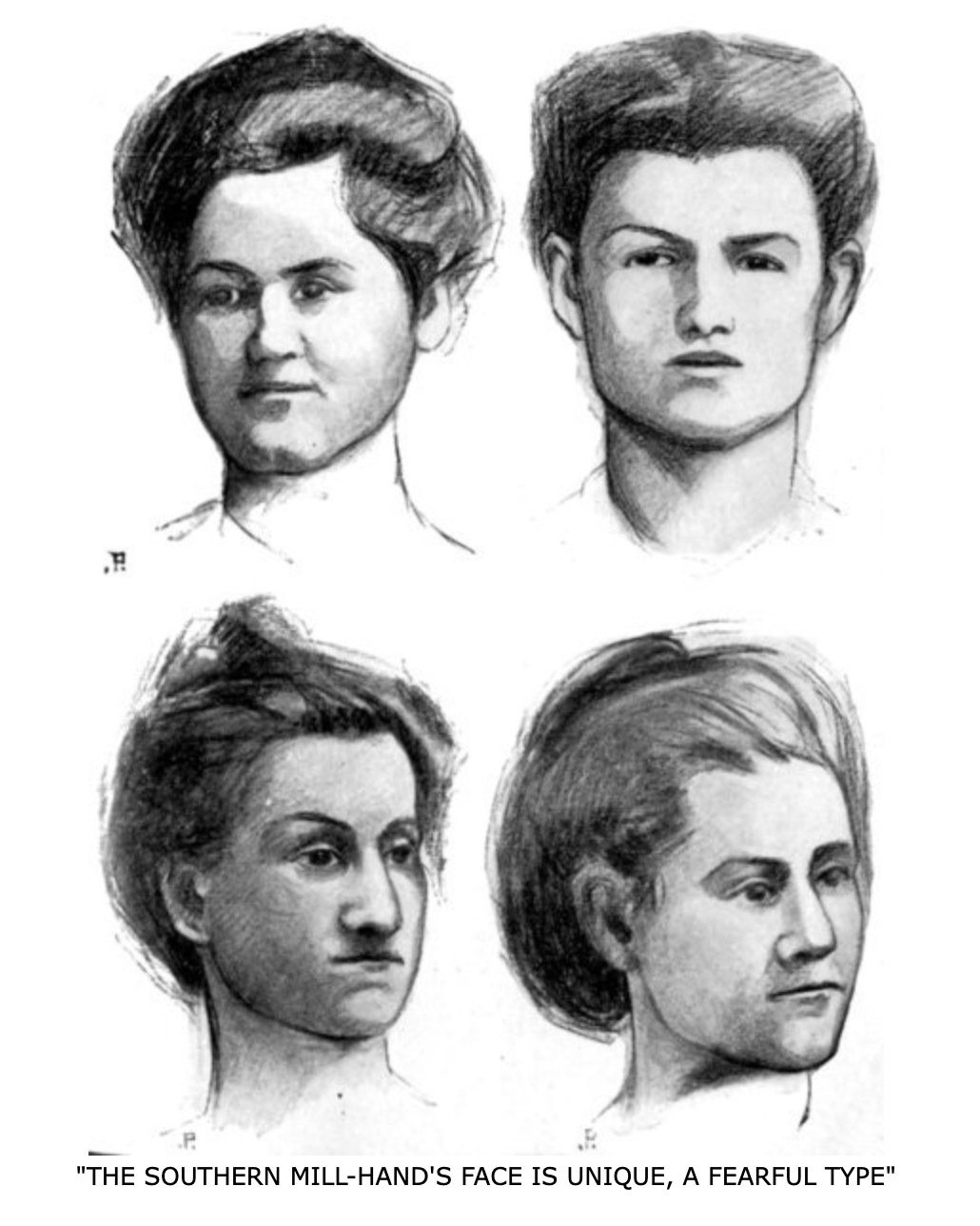
Marie's Southern Mill Towns: The two-part finale, "The Southern Cotton Mill," samples two pseudonymous South Carolina mills outside the town of Columbia. Her study was modeled on any number of large-scale companies whose "manufacture" gave "the city precedence and commercial value" (72). The mill itself was "a careful, well-considered building" (92). In contrast to this approval of Lynn's well-earned importance, there is a sting in Marie's accurate statement. Hugely profitable for the businessmen, the venue was, she stressed, a fiefdom, the mill was the "pride of the architect and the commercial magnate" (98). In this investigation, Marie takes aim at what WWT hitherto repressed: milltown motherhood. If this is a new subject in a "strange country," it is also a new Marie. Her sister-in-law averred she never saw mothers and children in Perry (72). In Lynn, Marie also denied the sight. That omission also freed both authors to develop a narratology of the self-supporting female underclass. In that way, the two authors could filter their representations of unmarried girls through their own single lives. (At her dying groom's behest, Bessie went from wife to widow in a day; Marie was unmarried.) But in choosing to infiltrate a Southern, poor-white, mill world, Marie knew the subject was a fraught one. Textile work was a venerable woman's trade in America, but in the Carolinas, it was inflected by the "racial, gender, and political order of the old South" (Fraser 237). Throughout WWT, the authors noted but saw no need to cavil at the race-based rule that Black women were given the most degrading jobs. In the mill towns of the South, they were barred completely (86). The real "waste men and waste women" (Isenberg 42) were poor whites (Isenberg 42). Reviled for their origins as hillbilly migrants, they were labeled "white trash," a term Marie employs (95). Viewing her education in Elizabethan literature another emblem of her worth, she reflects, "they are looked down upon as scum: and in good sooth, for good reason, scum they are!" (72). Women were particularly castigated, and Marie defends the view. Charging them with substituting twigs in their hair for hats, she paints a picture of the girls as barefoot and ignorant, as if they deliberately pervert fashion (72). To be hired, they must take out the tiny branches, abandoning their identities as creatures of the wood. They will put on some shoes, but they will still have "no means to be clean, no stimulus to be decent" (86). Painting a picture of girls from the hills as probably already wayward, she pinions them as "profane, contentious" and, repeating the first charge, "foul-mouthed" (84). Like her collaborator, she melds dirty language with poor hygiene. And, like Bessie, she reminds herself that they are "still human beings" – even if they "slouch" in and out of rooms and eat with their fingers (80, 99). On the workflow itself, Marie's departure from the lady-worker persona of the civilized Lynn job world is especially dramatic. The classic study Out to Work: A History of Wage-Earning Women in America juxtaposed a photo of the most skilled workers exiting a shoe factory in stylish attire. This image tallies with Marie's reference to the luxuries of fur collars and gloves. The picture below, in a North Carolina mill, shows soiled dress, consonant with Marie's allusions to stains from machine oil and sweat (Kessler-Harris 129). We know that the Van Vorsts coded dirt as a mind-body class signifier. Marie resists identifying with the smelly cadre that leaves work with cotton dust all over her. They are aptly called "lintheads," women whose hair was so affected. Refusing to disappear into the mass, she qualifies the damage to her own appearance by dubbing her own hairdo "far from tidy" and quotes with satisfaction a foreman's comment on her obvious good health (86). Even reading in terms of Bessie's insect-laden Chicago shop, Marie's mill regimen requires taking her dirt home. There are several reasons for her weeks long presence. In no special order, Van Vorst found its shock value, topical urgency, and appeal to conscience undeniable. Of equal importance, her expose of mill women's dehumanized offspring in the last section of the WWT built her public profile. So did her novel in the following year, Amanda of the Mill. Despite its Pygmalion plotting, this child-to-lady story drew on her WWT findings. There were relatively few southern women and children in nonfarm tasks, but the majority of those, usually from backwoods families, was successfully and fraudulently recruited for the mills with promises of better lives. Of those, easily one-third were married, and a large majority shared the domestic goal. The sight of unwashed women and their female children (more tractable than boys) in their designated sections of the mill initially caused her to condemn the practices of greedy employers. As she learned by doing, she provided lucid explanations of the ten-hour days of spooling, threading, and spinning. She prefigured the next decade's many investigative committees. Explained in a 1911 Senate report on the textile trades, "The father with wife and children dependent upon him for support – is not found in the southern mills" (qtd. in Kessler-Harris 122). Apparently, the only counterpart was in northern sites staffed by the bottom tier immigrants. Investigators viewed their unfortunate subjects as industrial peasants; Van Vorst's text heightened this moralizing. In the South's textile autocracy, unnatural female work had an even harsher meaning. Though incensed by the family wage system, she found the mothers guilty of flirtatiousness. Whether shocked by or anxious about out-of-wedlock liaisons, she focuses on a sexual instability that leads them to contract a "'mill marriage' that is little binding to him, and which will give her children in time to the mill" (87, emphasis mine). In place of damning the father for his sordid motives, Marie accepts the normative discrimination against women. It is they who are without regard for child-bearing consequences, ready to waste management time and defy anti-fraternization warnings. More than their men, they create the "farce" of mill marriage, with illegitimate children often the order of the day (89). If the sometime husband is feckless, the wife is a parody of motherhood. An artist's rendering of a hillbilly quartet filters Marie's impression and provides a quotation from the text:
Figure 3
These women are the coarse, "low-browed, [and] sensual" (87), their personae the same as those who later married. In off-hand remarks, Marie noted that she hid a small camera in her pocket, surreptitiously photographing those in view (94). She does not indicate why only this self-assignment occasioned such an aid. Whether or not the photos were made available to the illustrator, what to later viewers was tame and – in three of the drawings – pleasing. There is more than a hint of vibrancy in the eyes of the woman on the upper left. Yet these pictures were meant to have the opposite effect in its time. That is, just as Marie filtered the onsite pictures through her perception of the frightening mill woman, the illustrator gave pictorial form to that judgment. In that sense, the sketch is true to Van Vorst's intent. It translates failings into a form reminiscent of metropolitan police departments' rogue galleries. Faithful to her version of their appearance, for instance, in the picture above, the hated hairstyle is not a gentlewoman's but looks "frowsy," actually lightened strands are due to lint. There is an enigmatic difference among the women. The person on the lower left shows signs of disability, the outer limits of Marie's rhetoric of cognitive impairment. Viewers of the time might have explained the woman's demeanor as evidence of poor-white inbreeding. Based on limited southern samplings, eugenic theories about hereditary feeble-mindedness and degeneracy, "they automatically focused on the South" (Isenberg 197). A criminalized lineage was at the heart of this pseudo-science, which based on a few incestuous families, refused to consider that pellagra could just as easily played a part. (In the most fervent quarters, the only "solution" was to prevent motherhood through involuntary sterilization.) President Roosevelt saw the problem differently: in his preface to the book, he charged that the "proper working class" was undermining "the race" by not reproducing ("Prefatory Letter," n.p.). He was horrified by birth control, but disdained the biologically inferior whites who propagated unhealthy children. Although she did not address Roosevelt's "race suicide" theory, Marie implicitly concurred. She was careful to praise the working-class wife and mother in the context of the "unmixed blood" of whites – with the exception of the mentally challenged lint force (96). Spurred to disgust at the "types" spawned by southern degeneracy, Marie nevertheless echoed Bessie’s ambivalence. She admitted gratitude for workplace tutelage by girls who were patient – and literate – but were nonetheless "young savages" (81). For all this sensationalism, the selling point of Marie's contribution was what one reviewer enthused was "the magnificent closing" of "The Child in the Southern Cotton Mills" (Colbron 47). While the rhetoric is familiar, these closing pages stand alone. Here, Marie earns her reputation as a progressive urging immediate government remedy. She displays a serious attitude to the question of child labor. Without visiting a model in Aragon, Georgia, she lauds a Mr. Wolcott for refusing to hire children. He is evidently similarly humane to his employees, although there is no mention of increased wages (99). Though mills of this sort are "divinely hoped for," they remain utopian (99). Marie evades Wolcott's policy on mothers to invoke the dark warnings feeding her maternal imaginary. As things stand, the neglected child labor is comprised of "pallid automatons" (96). The new generation remains low on the evolutionary scale. If change is not initiated, the grown-up children will, in the book's default narrative, be "creatures scarcely fit to be called human beings" (93). Compared to Bessie's sketches and her own Lynn portrait, Marie is unnerved by the Swiftian population of the female cotton mill South. But in a wider sense, her textile revelations join the four chapters that preceded it to reassert the tropes of dirt and "shocking morals." She also deplores illiteracy and damns the negligence of unfit workers, who collaborated in their own ugliness (84). But semi-civilized slovens and slatterns were not the only nemeses. Paradoxically, there was another form of working girls' social chaos linked to cities outside the primal South. It was the nemesis of independence, for it delayed or prevented life in the domestic sphere. In their battle against the "fake ladies" who were sustained by misspent wages on self-display, Marie again joined Bessie in calling out the factory girl.
Clothing the Truth: Fake Workers and Factory Ladies Of all the failings inherent in the Van Vorsts' wage earners, one of the most offensive was the way young women brought their sensation-seeking natures to the amusements of the modern city. Pretty girls not yet doomed by the machine regimen gossiped unwittingly with Bessie and Marie about dressing up for evenings with likely beaux and dance hall enjoyment. In a sweeping statement she does not try to support, Bessie recounts the universality of this desire and faulted such activity, as "not to save, but to give…[themselves] pleasure; not to spare others, but to exercise [their] will in spite of them" (29).
Speaking for Marie as well, Bessie found nothing to praise in the many labor hours needed to save for small adornments. The didactic inscribed above was that finery was a selfish prelude to the kind of "social adventuring" through dress that such frivolous purchases betokened about the consequences of flirting (Stansell 127). The Van Vorsts were reticent about this practice, although they probably agreed with the critics who fused gaudy clothing, socializing with strangers, and participating in the illicit (Blewett 179; Peiss 186). Buying clothes was a common enough prelude to escape, and the Van Vorsts were not alone in their distress. The resultant overreaction included those otherwise at odds from the high-minded Committee on the Amusements of Working Girls to the then-unorthodox defender, the novelist Theodore Dreiser. All cautioned that the young women who yoked new clothes and romance walked a dangerous path. One key remedy was the social settlement, epitomized by Jane Addams's famed Chicago Hull House. As her discoveries of the sewing shop reveal, Bessie was little interested in the self-improvement of ethnic women. She visited only to find advertisements for boarding houses. She had no time to visit classes where the serious Poles, Jews, and Italians who were Addams's chief concern learned important skills in sewing and cooking to find a better life despite the slum (25). Some now find Hull House betterment reconciled poor women to the class system (Lissak 25-33). Viewed thus, dressing up was an unwelcome assertion of self. Consuming fashion in this way roiled the Van Vorsts, but in a different way. Theirs was an overwrought response, but one tied to their identities as beautifully attired women. They mention their Paris fashions a dozen times in the text, and we recall Marie's list of examples. In this thematics of condescension, they fitted workers' dress-crazed effrontery into an odd appearance as moral defect. To the sisters-in-law, these were fake ladies who did not comprehend their "proper sphere of life" (53). For instance, a scrap of lace for fifty cents bought on the street exemplified the vulgar and trashy – so too a tasteless jacket sixty times cheaper than Marie's seal coat. In this variant on the dirtiness trope, this judgment applied to the wearers as well. Daring to be prideful, toilers no longer knew their place. The irony here is that real imitators were the Van Vorsts, who never wavered from pride in successful disguise. Furthermore, the two writers had nothing to fear from these young women. They knew that clothes alone could not make up for a lack of education or breeding, even in the rare instances that the parvenu's success elevated an ambitious or talented exception. But the tide had turned. By the early 1900s, there was greater freedom than in the prior decade for women who worked with their hands. What this pair of well-to-do women did not understand was that the girls themselves, as Nan Enstad's Ladies of Labor explains, devised their own style. They turned "a taste for what they could not afford" into pride at creativity (66). Embracing bricolage, they applied their seamstress capabilities to their own outfits. They revisioned their cut-rate adornment as a new way of dressing. They saw ways to proclaim their status as workers by decorating their hats in ingenious ways, festooning them with bunches of artificial flowers, and feathers, all to the accompaniment of modish blouses, skirts, and high heeled shoes. Nan Enstad contends that these young women did not aspire to the "tasteful but to surprise and shock" (78). Whether that was a universal motive, theirs was a new self-fashioning, in both senses of the word. If they were invisible at work, they made up for it in afterwork expressiveness. In tune with urban sartorial modernism, they acted as female proletarian flaneurs. They claimed the right to apply the lessons of shop windows and the attire of stylish women they passed. Rather than accede to civic scorn, they chipped away at the lady and her moral superiority ideal. They appropriated key elements of the ideology but crafted them to their own purposes. Without denying their exploitation, they dressed to proclaim the dignity of labor. To borrow from the historian of costume Anne Hollander, they produced their own "images of clothed truth" (314). The workplace was not, in this practice, an obstacle to dressing up. Quite the opposite. In fact, the term "factory ladies" signified that they could embrace ladyhood when they elected to dress "high" (Enstad, "Fashioning" 5). If they still had limited agency as actors in their own lives, they heralded the possibilities of the decade to come. The final decoupling of the Van Vorsts' charge of phony gentility from wage-earners' stylishness occurred in watershed events like the Shirtwaist Strike of 1909. Inspiring workers elsewhere, immigrant women in New York City walked out en masse. It was they who struck first and were only eventually joined (and politically backgrounded) by men. As for so many important occasions, they wore their best clothes.
Conclusion The Van Vorsts manipulated the undercover mode to foreground the social disruption created by those who toiled outside the home. A sustained challenge to the WWT legacy had to await the next decade's Progressive movement, the halting entry of women into unionism, and the attendant emphasis on the true experience of female industrial labor. Even if they provided some sharp observations and pointed to the variety of woman-fueled light industries, these realities disappeared into a parallel universe. They were far from alone in questioning the human qualities of laboring women, although they were certainly in the vanguard. By privileging censure over reliability, their book cheapened rather than illuminated the period conversation. Because the two narrators assured themselves that they were voices for their subjects, WWT merits the above scrutiny as a valuable lesson in cultural tunnel vision. Sadly, the authors were rewarded for attitudes toward women workers that are still robust today.
Notes 1. For the primary source, I used Project Gutenberg, an authentic reprint, of the 1903 Doubleday, Page & Co. edition, to search the text for key phrases, internal inconsistencies, and the like. The illustrations are as they appear in that online text and are in the public domain. Knopf, now the copyright holder, has given permission to reproduce these images.
Addams, Jane. Twenty Years at Hull-House with Autobiographical Notes. 1910. U of Illinois P, 1990. Aron, Cindy Sondik. "Introduction." The Long Day: The Story of a New York Working Girl, by Dorothy Richardson, U of Virginia P, 1990, pp. ix-xxxvii. Auer, Caroline. "'A Transcript from Real Life': The Simulated Reality of the Social Reportage." Simulacrum America: The USA and the Popular Media, edited by Elizabeth Kraus and Caroline Auer, Camden House, pp. 169-80. Blewett, Mary H. We Will Rise in Our Might: Workingwomen's Voices from Nineteenth-Century New England. Cornell UP, 1991. Colbron, Grace Isabel. "A Book and a Preface." The Public, vol. 6, no. 317, 25 April 1903, pp. 47-48. Conway, Kellyanne. Interview by Chuck Todd. Meet the Press. NBC, 22 January 2017. Enstad, Nan. "Fashioning Political Identities: Cultural Studies and the Historical Construction of Political Subjects." American Quarterly, vol. 50, no. 4, 1998, pp. 745-782, jstor.org/stable/30042167 ---. Ladies of Labor, Girls of Adventure: Working Women, Popular Culture, and Labor Politics at the Turn of the Century. Columbia UP, 1999. Fraser, Steve. Mongrel Firebugs and Men of Property: Capitalism and Class Conflict in American History. Verso, 2019. Gay, Eva. [Eva MacDonald Valesh]. "'Mong Girls Who Toil." St. Paul Daily Globe, 25 March 1888, p. 9. Gutman, Judith Mara. Lewis W. Hine and the American Social Conscience. The Walker Company, 1967. Isenberg, Nancy. White Trash: The 400-Year Untold History of Class in America. Penguin Random House, 2017. Keeran, Roger. "The Woman Who Toils." ILR Review, vol. 30, no. 4, 1977, pp. 549-550. Kessler-Harris, Alice. Out to Work: A History of Wage-Earning Women. Oxford UP, 1982. Lissak, Rivka Shpak. Pluralism and Progressives: Hull House and the New Immigrants, 1890-1919. U of Chicago P, 1989. MacClean, Annie Marion. "Two Weeks in Department Stores." American Journal of Sociology, vol. 4, no. 6, 1899, pp. 721-741. Mantel, Hilary. "The Princess Myth: Hilary Mantel on Diana." The Guardian, 26 August 2017, theguardian.com/books/2017/aug/26/the-princess-myth-hilary-mantel-on-diana Nestor, Agnes. Woman's Labor Leader: An Autobiography. Bellevue Books, 1954. Peiss, Kathy. Cheap Amusements: Working Women and Leisure in Turn-of-the-Century New York. Temple UP, 1986. Pittenger, Mark. Class Unknown: Undercover Investigations of American Work and Poverty from the Progressive Era to the Present. NYU P, 2012. Roosevelt, Theodore. "Prefatory Letter from Theodore Roosevelt." The Woman Who Toils: Being the Experiences of Two Gentlewomen as Factory Girls, by Mrs. John Van Vorst and Marie Van Vorst, Doubleday, Page & Co., 1903, gutenberg.org/cache/epub/15218/pg15218-images.html Sklar, Katherine Kish. Florence Kelley, and the Nation's Work: The Rise of Women's Political Culture, 1830-1900. Yale UP, 1997. Strong, Melisssa J. "Gender Trouble in The Long Day." Americana: The Journal of American Popular Culture, 1900 to Present, vol. 14 , no. 1, 2015, 2025, americanpopularculture.com/journal/articles/spring_2025/strong.htm Tice, Karen W. Tales of Wayward Girls and Immoral Women: Case Records and the Professionalization of Social Work. U of Illinois P, 1998. Todd, Kim. Sensational: The Hidden History of America's "Girl Stunt Reporters." Perennial Books, 2021. "Two Ladies as Factory Girls." New York Times Book Review, 21 March 1903, p. 30. Van Vorst, Mrs. John and Marie Van Vorst. The Woman Who Toils: Being the Experiences of Two Gentlewomen as Factory Girls. Doubleday, Page & Co., 1903, gutenberg.org/cache/epub/15218/pg15218-images.html |
Journal Home
AmericanPopularCulture.com