

|
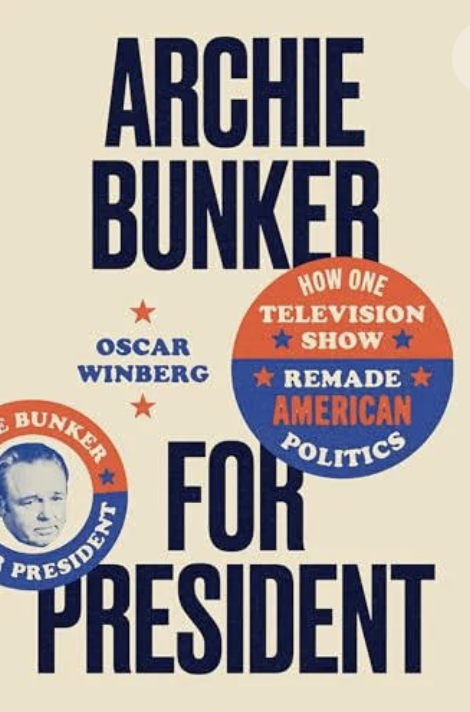
Featured Guest A political historian widely published and interviewed in popular media, Oscar Winberg holds a Ph.D. in history from Abo Akademi University and currently serves as a Postdoctoral Fellow at the Turku Institute for Advanced Studies as well as the John Morton Center for North American Studies at the University of Turku. What follows is a discussion centered around his award-winning book, Archie Bunker for President: How One Television Show Remade American Politics (University of North Carolina Press, 2025).
What single piece of evidence convinced you that a television sitcom had such a lasting political and historical impact?
Norman Lear created Archie Bunker as a satirical critique, but some viewers embraced and still embrace Archie as a hero rather than recognizing him as the target of the show's satire. What are your thoughts on this point?
Would you say All in the Family both reflected and changed the moment in American politics? Yes. Of course, All in the Family, like most good television entertainment, reflected the moment. But it also changed the moment. Now, let me be clear: All in the Family didn't elect George McGovern president, All in the Family didn't enact the Equal Rights Amendment, All in the Family didn't end bigotry. But it did change — even if for a brief moment — the national conversation. It made "dingbat" and "meathead" household terms. More importantly, it took part in and sometimes changed conversations around prejudices, sexual assault, lgbtq+ rights, and so much more. That matters. My work, however, is more focused on the specific ways the show changed political institutions and movements by convincing candidates, strategists, and activists that it mattered. In response, political interests attempted to use, and at times abuse, the show to advance their agenda. The success and influence of All in the Family is, in part, a result of changes in both the television industry and the political world in the early 1970s. That's the story I'm attempting to tell in my book.
As you look at contemporary television and media culture, is there a modern equivalent of Archie Bunker or All in the Family — a program that is redefining political conversation in the way Lear’s show did half a century ago? Well, there's definitely not a show that would have anything close to the reach of All in the Family, simply because the television landscape is so fundamentally different today from what it was in the network era. Cable, streaming, and social media have fragmented our viewership in ways that makes it impossible for one show to enjoy the same popularity and influence as All in the Family could in the 1970s or a show like Seinfeld could in the 1990s. Having said that, there are shows that do follow in the footsteps of All in the Family in terms of remaking political conversations. The one that first comes to mind is South Park. Trey Parker and Matt Stone might have a more niche audience than Norman Lear did, but the sheer outrageousness of the show — in particular the way it addresses the current political moment with merciless mockery of the Trump administration — has once again catapulted it into the political conversation and boosted the ratings of the show.
What one lesson do you hope readers can learn from your book, regarding the relationship between entertainment, free speech, satire, and political polarization? Remember that television entertainment and politics are intertwined in the United States because it benefits both parties. "It may not be good for America," the head of CBS famously concluded about the media spectacle of the 2016 presidential race, "but it's damn good for CBS." The development of new forms of political media and communication strategy is never inevitable. Rather, it is the result of the work and investment of ambitious political, media, and business interests.
Leslie Kreiner Wilson, Interviewer and Editor https://americanpopularculture.com/journal/articles/spring_2026/winberg.htm
|



AmericanPopularCulture.com


